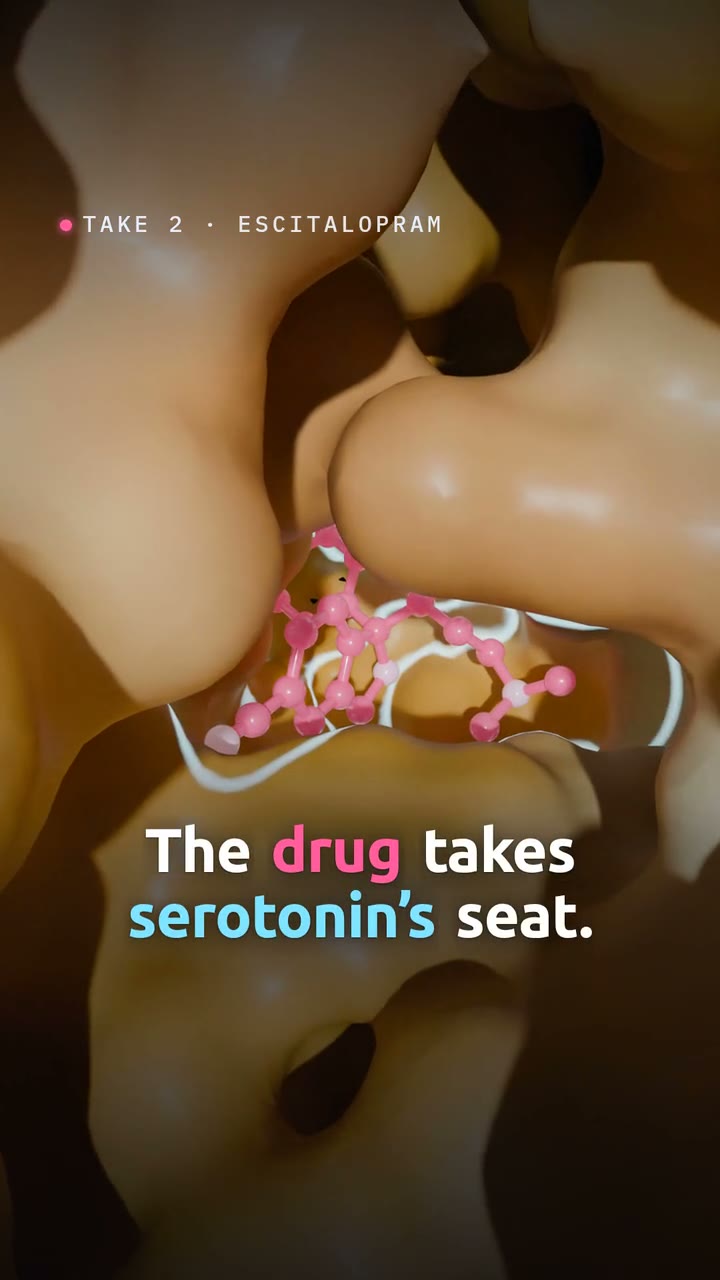
One-minute film · Antipsychotics · dopamine D2
A dimmer, not an off switch
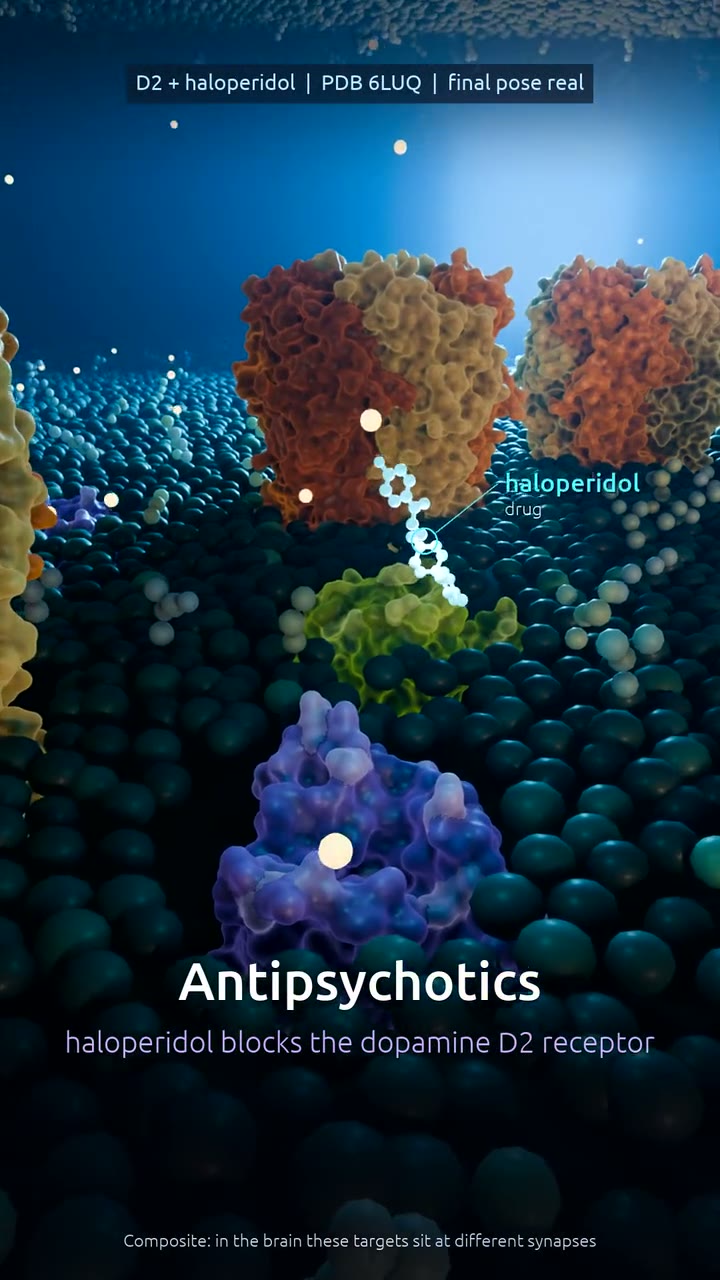
The film starts from the textbook pathway: dopamine activates the D2 receptor, which switches on a Gi protein that turns down adenylyl cyclase, so the neuron makes less cAMP. It then replays the cycle with the same dopamine present: with haloperidol, which blocks D2, Gi stays at rest and cAMP stays high; with a partial agonist (cariprazine), fewer Gi proteins switch on and cAMP falls only part-way. How far a partial agonist turns the receptor on depends on the assay (about 25–90% of dopamine's effect for aripiprazole), so the 'dimmer' setting is not one fixed number.
Timing, counts and motion are illustrative; the cariprazine pose is modelled from a D3 receptor structure, and the cyclase shown (AC9) stands in for striatal AC5.
Made in the Landau Lab in October 2026 as a one-minute trailer for the CINP International Course in Psychopharmacology (2027).
Where the images and numbers come from
Sources
- Zhuang et al. 2021, Cell (active D2 receptor with its Gi protein, PDB 7JVR)
- Knight et al. 2024, Nat Commun (dopamine bound in D2, PDB 8U02)
- Fan et al. 2020, Nat Commun (haloperidol bound in D2, PDB 6LUQ)
- Hadas Yardeni et al. 2026, Sci Adv (cariprazine bound in D3, PDB 9T8C; pose modelled into D2)
- Wang et al. 2018, Nature (inactive D2 receptor, PDB 6CM4; start of the shape change)
- Qi et al. 2019, Science (adenylyl cyclase 9, PDB 6R3Q, standing in for striatal AC5)
- Beaulieu & Gainetdinov 2011, Pharmacol Rev (the dopamine → D2 → Gi → adenylyl cyclase → cAMP pathway)
- Burris et al. 2002, J Pharmacol Exp Ther (partial-agonist efficacy about 25–90% of dopamine, assay-dependent; measured for aripiprazole)