Minipigs · brain slices
What else changes in these brains?
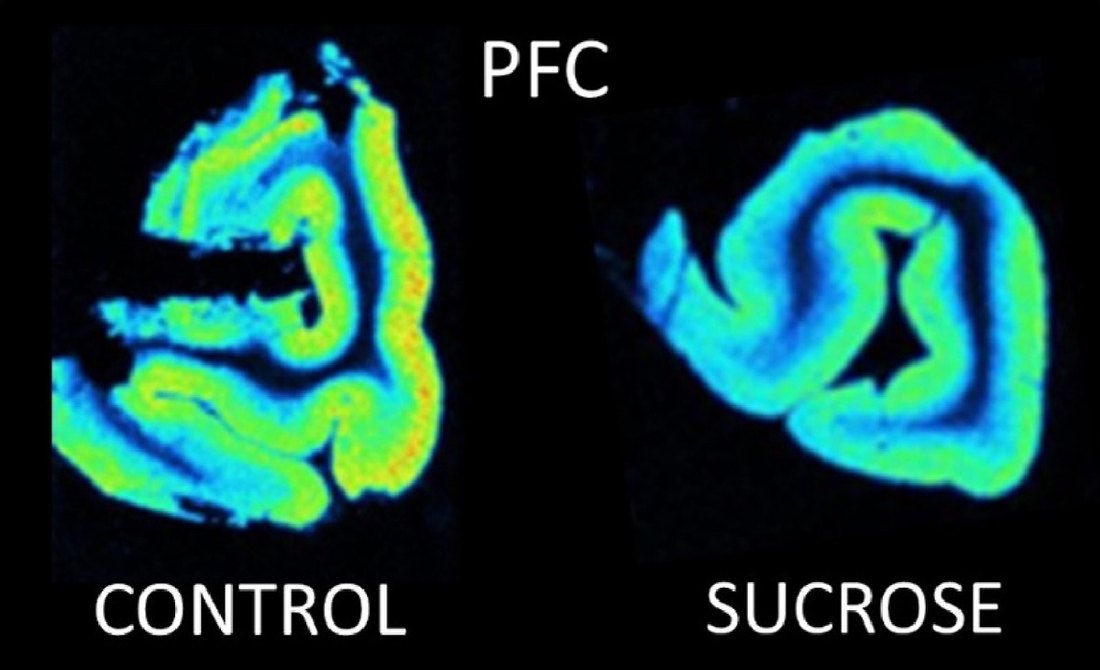
This image shows SV2A binding in the prefrontal cortex of minipigs, lower after 12 days of sucrose (Bærentzen et al. 2024). Earlier PET in the same pigs showed lower opioid receptor availability (Winterdahl et al. 2019). We still have brain slices from these pigs to explore with other tracers.
You could apply another tracer to these slices, learn to quantify the images, and compare brain regions between sucrose and control pigs.
MethodsAutoradiography with other tracers on existing brain slices
Synaptic imaging →
Image: Bærentzen et al., Neuropharmacology 2024, CC BY 4.0
Dopamine and GPR6
What does GPR6 do in models of Parkinson's disease and depression?
GPR6 is an orphan receptor concentrated in the dopamine D2 receptor-carrying neurons of the striatum. We ask how changing it affects striatal function and behaviour in these models.
Depending on the project, you could contribute to autoradiography, molecular analyses or behavioural data analysis, helping us understand how GPR6 affects brain function and behaviour.
MethodsAutoradiography, PET, molecular analyses, behaviour
Dopamine and GPR6 →
Synaptic imaging
How do disease and treatments affect synapses?
We measure SV2A binding, a proxy for synaptic density, in disease models and after treatment.
You could learn to quantify SV2A autoradiography images and compare brain regions or experimental groups.
Methods[³H]UCB-J autoradiography on the BeaQuant, [¹¹C]UCB-J PET, tissue analyses
Synaptic imaging →
Neuroinflammation
How do the brain's inflammatory and glial responses change in disease?
We use three tracers on brain sections from disease models: [³H]PK11195 targeting TSPO, [³H]5-MOP targeting CSF1R, and [³H]BU99008 targeting imidazoline-2 binding sites to investigate astrocyte-associated changes.
You could quantify binding of these tracers, see how they differ across brain regions or experimental groups and, where suitable data are available, relate the results to histology.
MethodsAutoradiography on brain sections, histology
Neuroinflammation →
Mitochondria
Does the brain's energy machinery change in disease?
[³H]BCPP-EF binds mitochondrial complex I, the first enzyme of the respiratory chain. Mapping it on brain sections from models of Parkinson's disease and depression gives a regional measure related to energy metabolism.
You could learn to quantify these images, look for differences between brain regions or experimental groups and, where suitable data are available, compare findings with other markers measured in the same brains.
Methods[³H]BCPP-EF autoradiography
BeaQuant autoradiography →
PET and behaviour are possible in some projects. The scope and methods of each project depend on its duration and on ongoing experiments.